
Sports Injuries & Pain Management
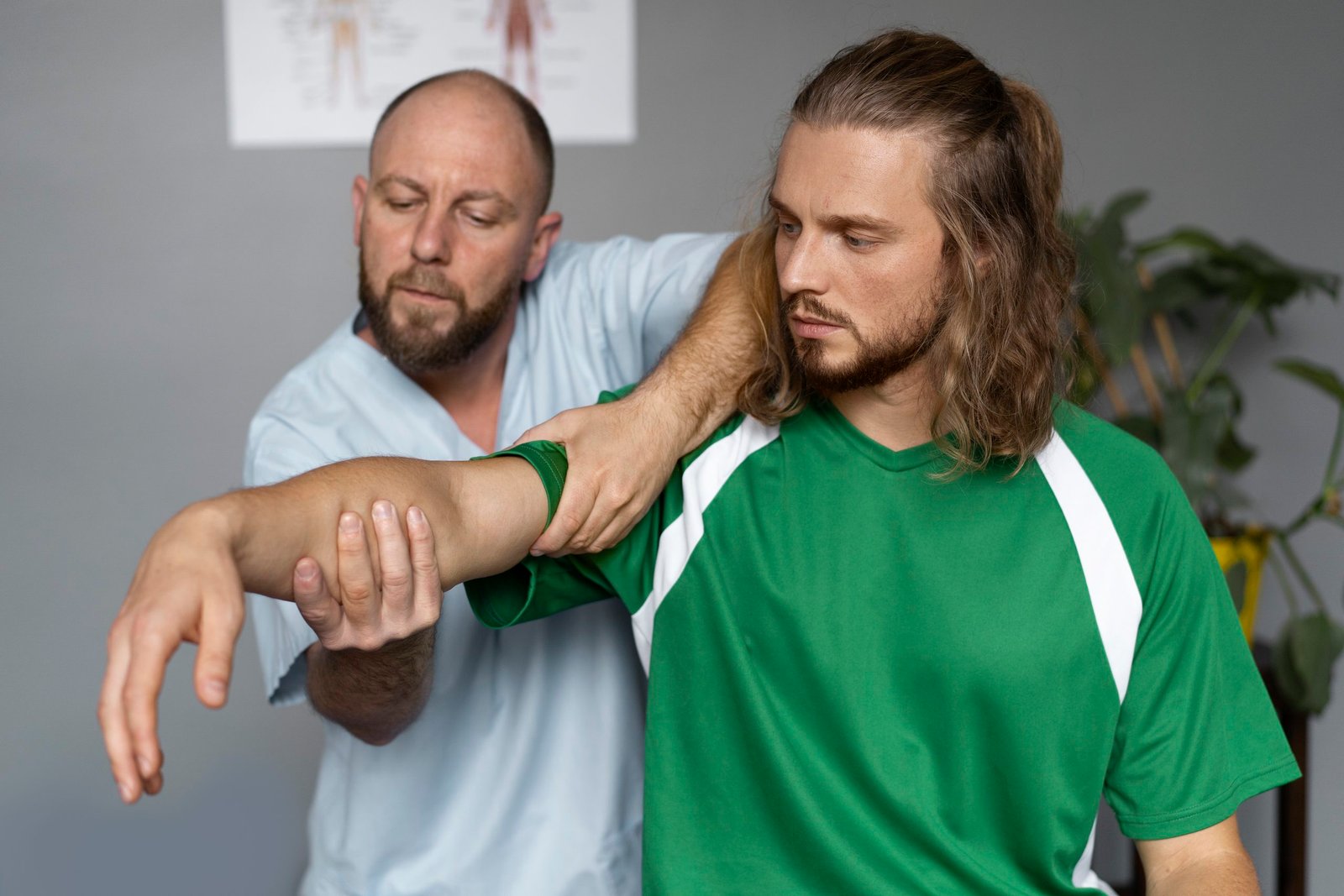
Accurate Diagnosis, Safe Return
The real question after an injury isn’t “when can I go back?” It’s “when can I go back safely without getting injured again?” We answer it with examination and testing, not guesswork.
- Clinical diagnosis supported by musculoskeletal ultrasound and imaging
- A staged plan ending in readiness testing before return to activity
- Graded pain solutions — from conservative care to guided injection
What injuries and pain conditions does the department treat at Sira Clinics?
The sports injury and pain management department at Sira Clinics in Madinaty treats: ACL, collateral ligament, and meniscal injuries; muscle tears and strains; ankle sprains and recurrent instability; tendinopathies (rotator cuff, tennis elbow, Achilles tendon, plantar fasciitis); joint osteoarthritis and its pain; and chronic pain of the neck, back, and joints. Treatment options include conservative and rehabilitative programmes, ultrasound-guided injections, and platelet-rich plasma (PRP) injections, with surgical referral where indicated.
The 3 Topics Our Visitors Search Most
1. ACL and knee injuries — is surgery inevitable?
How does it happen? Usually without contact with another player: a sudden change of direction, a bad landing, or a hard deceleration. Many describe an audible “pop,” followed by rapid swelling within hours and a sense that the knee is “unstable” or about to give way.
Diagnosis: clinical examination (Lachman, anterior drawer, and pivot shift tests), then an MRI to confirm the diagnosis and identify associated injuries — ACL tears frequently occur alongside meniscal or collateral ligament damage.
Is surgery inevitable? No — the decision rests on three factors:
Degree of tear: partial or complete.
Your activity profile: sports requiring rapid direction change (football, basketball, tennis) demand a fully stable knee. Someone who walks, cycles, or swims may do very well on a strengthening programme without surgery.
Degree of instability: does your knee buckle unexpectedly in daily life? That’s a strong argument for surgery.
What many people don’t realize: even when surgery is chosen, prehabilitation markedly improves the final outcome. Going into surgery with a swollen knee and a wasted quadriceps makes recovery longer and harder. So we begin rehabilitation from day one of the injury, whether or not surgery is decided.
When do you return to the field? Not after “six months” because it’s a familiar number. After passing functional readiness testing: quadriceps strength symmetry between legs of at least 90%, hop and landing tests, and psychological confidence in the knee. Returning before meeting these criteria is the leading cause of a second injury.
2. I’ve just been injured — what do I do in the first 72 hours?
Correct initial management saves weeks of recovery. Current guidance has moved on from the old RICE formula:
In the first two to three days — protect, don’t overdo:
- Protect: stop the activity and avoid painful loading for the first one to three days. Prolonged complete rest is not helpful — it weakens tissue.
- Elevate: raise the injured limb above heart level whenever possible to reduce swelling.
- Avoid anti-inflammatories in the first 48 hours where possible. Early inflammation is part of natural healing, and fully suppressing it at the outset may slow tissue repair. Ask your doctor about a suitable analgesic.
- Compress: an elastic wrap to control swelling.
- Ice: useful for pain relief. Use it intermittently — 15 minutes every couple of hours — and never directly against the skin.
After the first two days — move intelligently:
- Load progressively as pain allows. Early controlled movement accelerates healing and improves the quality of new tissue.
- Begin gentle range-of-motion exercises.
- Realistic optimism: fear of movement significantly prolongs injury duration.
- Light aerobic activity increases blood flow to the injured area.
When to see a doctor immediately, without waiting:
- You heard a pop at the moment of injury
- You can’t bear weight on the limb or take four steps
- Severe, rapid swelling within an hour
- Obvious deformity of the limb or joint
- Numbness, coldness, or pallor below the injury site
- No meaningful improvement within three to five days
The costliest mistake: returning to training “because the pain has gone.” Pain resolving doesn’t mean healing is complete — it usually just means the inflammatory phase has ended. The tissue needs additional weeks to regain strength.
3. PRP and guided injections — when do they actually help?
What is PRP? A small volume of your own blood is drawn and centrifuged to isolate a platelet-rich fraction containing growth factors, which is then injected into the injured area — usually under ultrasound guidance to guarantee accurate placement.
Where has it shown good results?
- Chronic tendinopathy that hasn’t responded to conservative treatment — tennis elbow is among the best-supported indications.
- Mild to moderate knee osteoarthritis — it can reduce pain and improve function for several months.
- Certain chronic tendon injuries such as Achilles tendinopathy and plantar fasciitis.
Where is the evidence weaker? Severe osteoarthritis, complete tears (no injection can reconnect a ruptured ligament), and several uses promoted without adequate research support.
How we decide in your case: we don’t start with injections. We escalate:
Conservative treatment first: activity modification, a rehabilitation programme, physiotherapy, and analgesia where needed.
Guided injection if the case hasn’t responded over an adequate period — and we explain the difference between two options candidly:
Corticosteroid: strong, fast pain relief, but limited in how often it can be repeated. Repeated doses can weaken tendon and harm cartilage long-term.
PRP: slower to act (results typically appear at 4 to 6 weeks), but it targets healing stimulation rather than merely suppressing inflammation. It may require one to three sessions.
Ultrasound-guided injection wherever possible — because an injection placed “by feel” may deposit the medication outside the target, and the injection then fails for a purely technical reason rather than a lack of efficacy.
Surgical referral where the case warrants it — without delay and without futile attempts.What we’ll always tell you plainly: injections are not a magic solution and do not replace rehabilitation. An injection opens a window of reduced pain — investing that window in a proper strengthening programme is what produces the lasting result. People who inject and then sit still return to us months later with the same complaint
Why Choose Sira Clinics for Your Injury
- Diagnosis before treatment. A full clinical examination supported by musculoskeletal ultrasound and imaging where needed — we don’t treat “knee pain,” we treat a specific cause.
- Honest treatment escalation. We always start with the least invasive option. No injection or surgery will be offered before simpler, safer measures are exhausted.
- Ultrasound-guided injections. Placement accuracy is half the result.
- Rehabilitation in the same building. Diagnosis, injection, physiotherapy, and the return-to-activity programme — under one roof with one team that talks to itself.
- Measurable return criteria. We don’t declare you “recovered” without evidence. There are functional tests and numbers that determine your readiness.
FAQs
Q: Do I need an MRI for every injury? A: No. Many injuries are diagnosed clinically and with ultrasound. MRI is requested where a ligament or meniscal injury is suspected, or where a case isn’t improving as expected.
Q: How long does recovery take? A: It varies dramatically: a mild muscle strain one to three weeks, a moderate ankle sprain 4 to 6 weeks, chronic tendinopathy 3 to 6 months, and ACL rehabilitation 6 to 9 months. You’ll receive a realistic timeline after diagnosis.
Q: Are PRP injections painful? A: There’s a sensation of pressure and moderate pain during the injection and for a day or two afterwards — expected, since the aim is to trigger a healing response. We use local anaesthetic and give you clear post-injection instructions.
Q: When can I return to training? A: When you meet defined criteria that we measure with you — not simply when pain disappears. We explain those criteria from the start so you know exactly what you’re working toward.
Q: Can knee osteoarthritis be treated without surgery? A: In mild and moderate grades, yes in many cases: weight reduction, quadriceps strengthening, activity modification, and guided injection where needed. Surgery is discussed in advanced grades or where conservative treatment has failed.Q: Do you treat non-professional athletes? A: Certainly — most of our patients are. Club players, recreational runners, and gym-goers sustain the same injuries and deserve the same diagnostic precision.
Book a Consultation
Consult with one of our specialists about the topics discussed in this article.
📅 Book Now